Idealised ocean alkalinity enhancement (OAE)
In this example we setup a 3D model driven by a constant wind stress, with 3 instances of the carbon chemistry system (DIC, alkalinity, and particulate inorganic carbon):
- the control, which receives no alkalinity,
- the release with secondary precipitation disabled (
calcium_carbonate_precipitation_rate = 0), - the release with secondary precipitation active.
Replicates 1 and 3 differ only by the alkalinity release, so their difference is the OAE signal; replicates 2 and 3 differ only by the precipitation rate, so their difference is what secondary precipitation costs.
We use ExplicitCalciumCarbonate rather than CarbonateSystem so that the particulate inorganic carbon formed by the calcifiers, and by abiotic precipitation once the alkalinity addition pushes the saturation state Ω up, is carried as its own sinking CaCO₃ tracer rather than being routed straight back into DIC/Alk.
Install dependencies
First we ensure we have the required dependencies installed
using Pkg
pkg "add OceanBioME, Oceananigans, CairoMakie"
Model setup
using Oceananigans, OceanBioME, Oceananigans.Units, CUDA

using OceanBioME.Models.GasExchangeModel: CarbonDioxideConcentration
using OceanBioME.Models.CarbonChemistryModel: KSP_aragonite
we define the grid and the biogeochemistry, adding in the inorganic_carbon with 3 replicates
grid = RectilinearGrid(GPU();
                       size = (64, 64, 8),
                       extent = (500, 500, 15))

precipitation_rate = 0.03 / day3.472222222222222e-7use aragonite rather than the default calcite solubility, as that is the phase usually discussed in the OAE secondary precipitation literature
carbon_chemistry = CarbonChemistry(; calcium_carbonate_solubility = KSP_aragonite())

biogeochemistry = LOBSTER(grid;
                          inorganic_carbon =
                              ExplicitCalciumCarbonate(grid;
                                                       replicates = 3,
                                                       carbon_chemistry,
                                                       calcium_carbonate_precipitation_rate =
                                                           (precipitation_rate, 0, precipitation_rate),
                                                       calcium_carbonate_precipitation_exponent = 3))
NutrientsPlanktonDetritus{Float64} with (:NO₃, :NH₄, :P, :Z, :DOM, :sPOM, :bPOM, :DIC1, :DIC2, :DIC3, :Alk1, :Alk2, :Alk3, :CaCO₃1, :CaCO₃2, :CaCO₃3)
Light attenuation: TwoBandPhotosyntheticallyActiveRadiation{Float64}
Sediment: Nothing
Particles: Nothing
Modifiers: NothingSecondary precipitation is off by default, so we turn it on for replicates 1 and 3. The rate law is
\[\text{precipitation} = k \max(0, \Omega - 1)^n [CaCO_3],\]
following the empirical description of calcite precipitation from seawater of Zuddas and Mucci (1994) and Zuddas and Mucci (1998). This example is a fictional scenario with fictional parameter values for k and n, chosen only to give a visible, numerically well-behaved precipitation signal - they should not be read as literature values or as a prediction of a real deployment.
Next we have to construct the boundary conditions for the DIC, changing the defaults to specify that the DIC and Alkalinity for each realisation's calculation should be its own DIC1/Alk1, DIC2/Alk2, or DIC3/Alk3. Then we can put the boundary conditions together.
wind_speed = 5 # m/s
Cᴰ = 2e-3
ρₐ = 1.2
ρₒ = 1026

CO₂_flux1 =
    CarbonDioxideGasExchangeBoundaryCondition(;
        wind_speed,
        water_concentration = CarbonDioxideConcentration(; DIC = :DIC1,
                                                           Alk = :Alk1)
    )
CO₂_flux2 =
    CarbonDioxideGasExchangeBoundaryCondition(;
        wind_speed,
        water_concentration = CarbonDioxideConcentration(; DIC = :DIC2,
                                                           Alk = :Alk2)
    )
CO₂_flux3 =
    CarbonDioxideGasExchangeBoundaryCondition(;
        wind_speed,
        water_concentration = CarbonDioxideConcentration(; DIC = :DIC3,
                                                           Alk = :Alk3)
    )

wind = FluxBoundaryCondition(-ρₐ/ρₒ * Cᴰ * wind_speed^2)

boundary_conditions = (; DIC1 = FieldBoundaryConditions(top = CO₂_flux1),
                         DIC2 = FieldBoundaryConditions(top = CO₂_flux2),
                         DIC3 = FieldBoundaryConditions(top = CO₂_flux3),
                         u    = FieldBoundaryConditions(top = wind))
(DIC1 = Oceananigans.FieldBoundaryConditions, with boundary conditions
├── west: DefaultBoundaryCondition (FluxBoundaryCondition: nothing)
├── east: DefaultBoundaryCondition (FluxBoundaryCondition: nothing)
├── south: DefaultBoundaryCondition (FluxBoundaryCondition: nothing)
├── north: DefaultBoundaryCondition (FluxBoundaryCondition: nothing)
├── bottom: DefaultBoundaryCondition (FluxBoundaryCondition: nothing)
├── top: FluxBoundaryCondition: DiscreteBoundaryFunction with GasExchange
└── immersed: DefaultBoundaryCondition (FluxBoundaryCondition: nothing), DIC2 = Oceananigans.FieldBoundaryConditions, with boundary conditions
├── west: DefaultBoundaryCondition (FluxBoundaryCondition: nothing)
├── east: DefaultBoundaryCondition (FluxBoundaryCondition: nothing)
├── south: DefaultBoundaryCondition (FluxBoundaryCondition: nothing)
├── north: DefaultBoundaryCondition (FluxBoundaryCondition: nothing)
├── bottom: DefaultBoundaryCondition (FluxBoundaryCondition: nothing)
├── top: FluxBoundaryCondition: DiscreteBoundaryFunction with GasExchange
└── immersed: DefaultBoundaryCondition (FluxBoundaryCondition: nothing), DIC3 = Oceananigans.FieldBoundaryConditions, with boundary conditions
├── west: DefaultBoundaryCondition (FluxBoundaryCondition: nothing)
├── east: DefaultBoundaryCondition (FluxBoundaryCondition: nothing)
├── south: DefaultBoundaryCondition (FluxBoundaryCondition: nothing)
├── north: DefaultBoundaryCondition (FluxBoundaryCondition: nothing)
├── bottom: DefaultBoundaryCondition (FluxBoundaryCondition: nothing)
├── top: FluxBoundaryCondition: DiscreteBoundaryFunction with GasExchange
└── immersed: DefaultBoundaryCondition (FluxBoundaryCondition: nothing), u = Oceananigans.FieldBoundaryConditions, with boundary conditions
├── west: DefaultBoundaryCondition (FluxBoundaryCondition: nothing)
├── east: DefaultBoundaryCondition (FluxBoundaryCondition: nothing)
├── south: DefaultBoundaryCondition (FluxBoundaryCondition: nothing)
├── north: DefaultBoundaryCondition (FluxBoundaryCondition: nothing)
├── bottom: DefaultBoundaryCondition (FluxBoundaryCondition: nothing)
├── top: FluxBoundaryCondition: -5.84795e-5
└── immersed: DefaultBoundaryCondition (FluxBoundaryCondition: nothing))Next we define an alkalinity release in a circle in the center for 1 hour
@inline alkalinity_release(x, y, z, t, params) =
    ifelse((params.start_time <= t < params.start_time + params.duration) &
            (z > params.depth) &
            ((x-250)^2 + (y-250)^2 < params.radius^2),
            params.release_rate, 0)

total_release = 2.5e7 # 1t NaOH = 25000mol NaOH = 2.5e7 meq Alk
duration = 1hour
depth = -1
radius = 50
release_rate = total_release/duration/(π*radius^2*abs(depth))

oae = Forcing(alkalinity_release;
              parameters = (; start_time = 20minutes,
                              duration,
                              release_rate,
                              radius,
                              depth))
ContinuousForcing{@NamedTuple{start_time::Float64, duration::Float64, release_rate::Float64, radius::Int64, depth::Int64}}
├── func: alkalinity_release (generic function with 1 method)
├── parameters: (start_time = 1200.0, duration = 3600.0, release_rate = 0.8841941282883075, radius = 50, depth = -1)
└── field dependencies: ()And then put the model together with Alk2 and Alk3 both receiving the release while Alk1 (the control) evolves normally
model = NonhydrostaticModel(grid;
                            coriolis = FPlane(latitude = 45),
                            boundary_conditions,
                            biogeochemistry,
                            advection = WENO(),
                            tracers = (:T, :S),
                            forcing = (; Alk2 = oae, Alk3 = oae))

set!(model, P = 1, NO₃ = 10,
            T = 15, S = 35,
            DIC1 = 2000, Alk1 = 2300, CaCO₃1 = 0.1,
            DIC2 = 2000, Alk2 = 2300, CaCO₃2 = 0.1,
            DIC3 = 2000, Alk3 = 2300, CaCO₃3 = 0.1,
            u = (x, y, z) -> randn()/2)
Then we can setup a simulation with a variable timestep and progress message and output the tracers, running for longer than the release itself so the air-sea flux has time to respond
simulation = Simulation(model, Δt = 5, stop_time = 4hours)

conjure_time_step_wizard!(simulation; cfl = 0.5)

prog(sim) =
    @info prettytime(sim)*" in "*prettytime(sim.run_wall_time)*" with Δt = "*prettytime(sim.Δt)

add_callback!(simulation, prog, IterationInterval(100))
we save the saturation states alongside the tracers so the state of the explicit calcium carbonate pool can be inspected
outputs = merge(model.tracers, (; Ω1 = model.auxiliary_fields.Ω1,
                                  Ω2 = model.auxiliary_fields.Ω2,
                                  Ω3 = model.auxiliary_fields.Ω3))

simulation.output_writers[:tracers] = JLD2Writer(model, outputs;
                                                filename = "oae.jld2",
                                                schedule = AveragedTimeInterval(20minutes),
                                                overwrite_files = true)
JLD2Writer scheduled on TimeInterval(20 minutes):
├── filepath: oae.jld2
├── 21 outputs: (T, S, NO₃, NH₄, P, Z, DOM, sPOM, bPOM, DIC1, DIC2, DIC3, Alk1, Alk2, Alk3, CaCO₃1, CaCO₃2, CaCO₃3, Ω1, Ω2, Ω3) averaged on AveragedTimeInterval(window=20 minutes, stride=1, interval=20 minutes)
├── array_type: Array{Float32}
├── including: [:coriolis, :buoyancy, :closure]
├── file_splitting: NoFileSplitting
└── file size: 0 bytes (file not yet created)We can also create a BoundaryConditionOperation which records the flux through the top boundary for both the DIC fields which we can save
qCO₂1 = BoundaryConditionOperation(model.tracers.DIC1, :top, model)
qCO₂2 = BoundaryConditionOperation(model.tracers.DIC2, :top, model)
qCO₂3 = BoundaryConditionOperation(model.tracers.DIC3, :top, model)

simulation.output_writers[:carbon_flux] = JLD2Writer(model, (; qCO₂1, qCO₂2, qCO₂3),
                                                     indices = (:, :, grid.Nz),
                                                     filename = "oae_surface_flux.jld2",
                                                     schedule = TimeInterval(20minutes),
                                                     overwrite_files = true)
JLD2Writer scheduled on TimeInterval(20 minutes):
├── filepath: oae_surface_flux.jld2
├── 3 outputs: (qCO₂1, qCO₂2, qCO₂3)
├── array_type: Array{Float32}
├── including: [:coriolis, :buoyancy, :closure]
├── file_splitting: NoFileSplitting
└── file size: 0 bytes (file not yet created)and then run the simulation
run!(simulation)[ Info: Initializing simulation...
[ Info: 0 seconds in 0 seconds with Δt = 2.500 seconds
[ Info: ... simulation initialization complete (1.374 minutes)
[ Info: Executing initial time step...
[ Info: ... initial time step complete (7.665 seconds).
[ Info: 5.212 minutes in 2.414 minutes with Δt = 4.996 seconds
[ Info: 18.483 minutes in 3.368 minutes with Δt = 12.959 seconds
[ Info: 47.006 minutes in 4.329 minutes with Δt = 21.097 seconds
[ Info: 1.326 hours in 5.288 minutes with Δt = 16.848 seconds
[ Info: 1.740 hours in 6.250 minutes with Δt = 12.560 seconds
[ Info: 2.074 hours in 7.210 minutes with Δt = 10.747 seconds
[ Info: 2.355 hours in 8.169 minutes with Δt = 9.616 seconds
[ Info: 2.604 hours in 9.123 minutes with Δt = 8.240 seconds
[ Info: 2.834 hours in 10.083 minutes with Δt = 8.474 seconds
[ Info: 3.061 hours in 11.049 minutes with Δt = 8.247 seconds
[ Info: 3.279 hours in 12.005 minutes with Δt = 7.388 seconds
[ Info: 3.493 hours in 12.963 minutes with Δt = 7.674 seconds
[ Info: 3.708 hours in 13.922 minutes with Δt = 7.763 seconds
[ Info: 3.914 hours in 14.887 minutes with Δt = 7.316 seconds
[ Info: Simulation is stopping after running for 15.301 minutes.
[ Info: Simulation time 4 hours equals or exceeds stop time 4 hours.
Finally we load the data and create some plots
using CairoMakie, Statistics

fds = FieldDataset("oae.jld2")
fds_surface = FieldDataset("oae_surface_flux.jld2")

n = Observable(1)

N = length(fds["P"])13compare replicate 3 (release, precipitation active) with replicate 1 (the control)
Δ_Alk = @lift (mean(interior(fds["Alk3"][$n]), dims=3)[:, :, 1] .-
               mean(interior(fds["Alk1"][$n]), dims=3)[:, :, 1]).* 15
Δ_qCO₂ = @lift (interior(fds_surface["qCO₂3"][$n], :, :, 1) .-
                interior(fds_surface["qCO₂1"][$n], :, :, 1)) .* (12+2*16)*1e-3*day

Δ_CaCO₃ = @lift (mean(interior(fds["CaCO₃3"][$n]), dims=3)[:, :, 1] .-
                 mean(interior(fds["CaCO₃1"][$n]), dims=3)[:, :, 1]) .* 15

Δ_Alk_range = maximum(abs, mean(interior(fds["Alk3"]), dims = 3) .-
                           mean(interior(fds["Alk1"]), dims = 3)) .* 15
Δ_CaCO₃_range = maximum(abs, mean(interior(fds["CaCO₃3"]), dims = 3) .-
                             mean(interior(fds["CaCO₃1"]), dims = 3)) .* 15
Δ_qCO₂_range = maximum(abs, interior(fds_surface["qCO₂3"]) .-
                            interior(fds_surface["qCO₂1"])) .* (12+2*16)*1e-3*day

xc = xnodes(fds["P"])
yc = ynodes(fds["P"])

fig = Figure(size=(1500, 500))

ax = Axis(fig[1, 1], aspect = DataAspect())
ax2 = Axis(fig[1, 2], aspect = DataAspect())
ax3 = Axis(fig[1, 3], aspect = DataAspect())

hm = heatmap!(ax, xc, yc, Δ_Alk, colormap = :balance, colorrange = (-1, 1) .* Δ_Alk_range)
hm2 = heatmap!(ax2, xc, yc, Δ_qCO₂, colormap = :balance, colorrange = (-1, 1) .* Δ_qCO₂_range)
hm3 = heatmap!(ax3, xc, yc, Δ_CaCO₃, colormap = :balance, colorrange = (-1, 1) .* Δ_CaCO₃_range)

Colorbar(fig[2, 1], hm, vertical = false,
                        label = "Alkalinity pertubation (mmol / m²)",
                        flip_vertical_label = true)
Colorbar(fig[2, 2], hm2, vertical = false,
                         label = "Surface CO₂ flux difference (gCO₂/m²/day)",
                         flip_vertical_label = true)
Colorbar(fig[2, 3], hm3, vertical = false,
                         label = "Calcium carbonate difference (mmol / m²)",
                         flip_vertical_label = true)

supertitle = Label(fig[0, :], (@lift prettytime(fds["P"].times[$n])))

CairoMakie.record(fig, "oae.mp4", 1:N, framerate=10) do i
    @info "$i"
    n[] = i
end"oae.mp4"fig = Figure(size = (1000, 750));
ax = Axis(fig[1, 1], title = "Surface flux (gC/day)")
surface_area = 500*500
mmol_to_g = 12/1000
mean_flux(name) = mean(interior(fds_surface[name], :, :, 1, :), dims = (1, 2))[1, 1, :]
total_carbon_flux1 = mean_flux("qCO₂1")
total_carbon_flux2 = mean_flux("qCO₂2")
total_carbon_flux3 = mean_flux("qCO₂3")
times = fds_surface["qCO₂1"].times ./ hours
lines!(ax, times, total_carbon_flux1 .* mmol_to_g * surface_area * day, label = "Control")
lines!(ax, times, total_carbon_flux2 .* mmol_to_g * surface_area * day, label = "Release, no precipitation")
lines!(ax, times, total_carbon_flux3 .* mmol_to_g * surface_area * day, label = "Release, precipitation",
linestyle = :dash)
Legend(fig[1, 2], ax)Legend()Cumulative difference in the air-sea CO₂ flux between replicate pairs
ax2 = Axis(fig[2, 1], title = "Cumulative CO₂ difference (gC)")

Δt_save = diff(fds_surface["qCO₂1"].times)[1]1200.0a negative flux is carbon entering the ocean, so a - b is the extra carbon taken up by b
cumulative_uptake(a, b) = cumsum(Δt_save .* (mean_flux(a) .- mean_flux(b)) .* mmol_to_g * surface_area)

lines!(ax2, times, cumulative_uptake("qCO₂1", "qCO₂2"),
       label = "Extra CO₂ taken up, no precipitation")
lines!(ax2, times, cumulative_uptake("qCO₂1", "qCO₂3"),
       label = "Extra CO₂ taken up, precipitation",
       linestyle = :dash)

Legend(fig[2, 2], ax2)

domain_volume = surface_area * 153750000Finally, the fate of the added alkalinity itself: how much has been realised as CO₂ uptake versus destroyed by precipitation. The uptake is converted to an alkalinity equivalent using the equilibrium efficiency $\eta = \Delta DIC / \Delta TA$, found by asking what DIC equilibrates with the atmosphere before and after an addition:
function equilibrium_DIC(Alk; target = 413.0, T = 15.0, S = 35.0)
    lo, hi = 1000.0, 3500.0
    for _ in 1:60
        mid = (lo + hi) / 2
        carbon_chemistry(; DIC = mid, Alk, T, S) < target ? (lo = mid) : (hi = mid)
    end
    return (lo + hi) / 2
end

η = (equilibrium_DIC(2400.0) - equilibrium_DIC(2300.0)) / 100

ax3 = Axis(fig[3, 1], xlabel = "Time (hours)", ylabel = "Alkalinity (meq)",
                      title = "Fate of the added alkalinity (replicate 3 vs control)")

TA_realised = cumsum(Δt_save .* (mean_flux("qCO₂1") .- mean_flux("qCO₂3")) .* surface_area) ./ η
TA_precipitated = [2 * mean(interior(fds["CaCO₃3"][i]) .- interior(fds["CaCO₃1"][i])) * domain_volume
                   for i in 1:N]

lines!(ax3, times, TA_realised, label = "Converted to CO₂ uptake")
lines!(ax3, fds["CaCO₃1"].times./hours, TA_precipitated, label = "Lost to precipitation")

Legend(fig[3, 2], ax3)

fig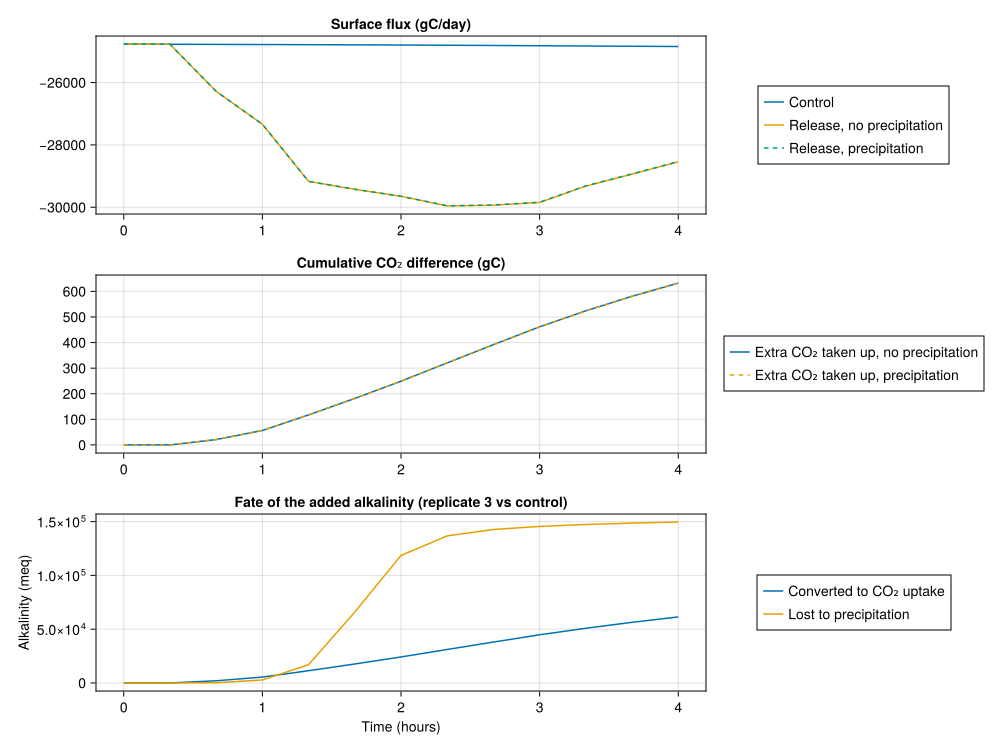
This page was generated using Literate.jl.